Polynomial Discovery
Multi-agent simulation where autonomous agents collaboratively learn a hidden cubic polynomial through noisy observations and peer-to-peer communication.
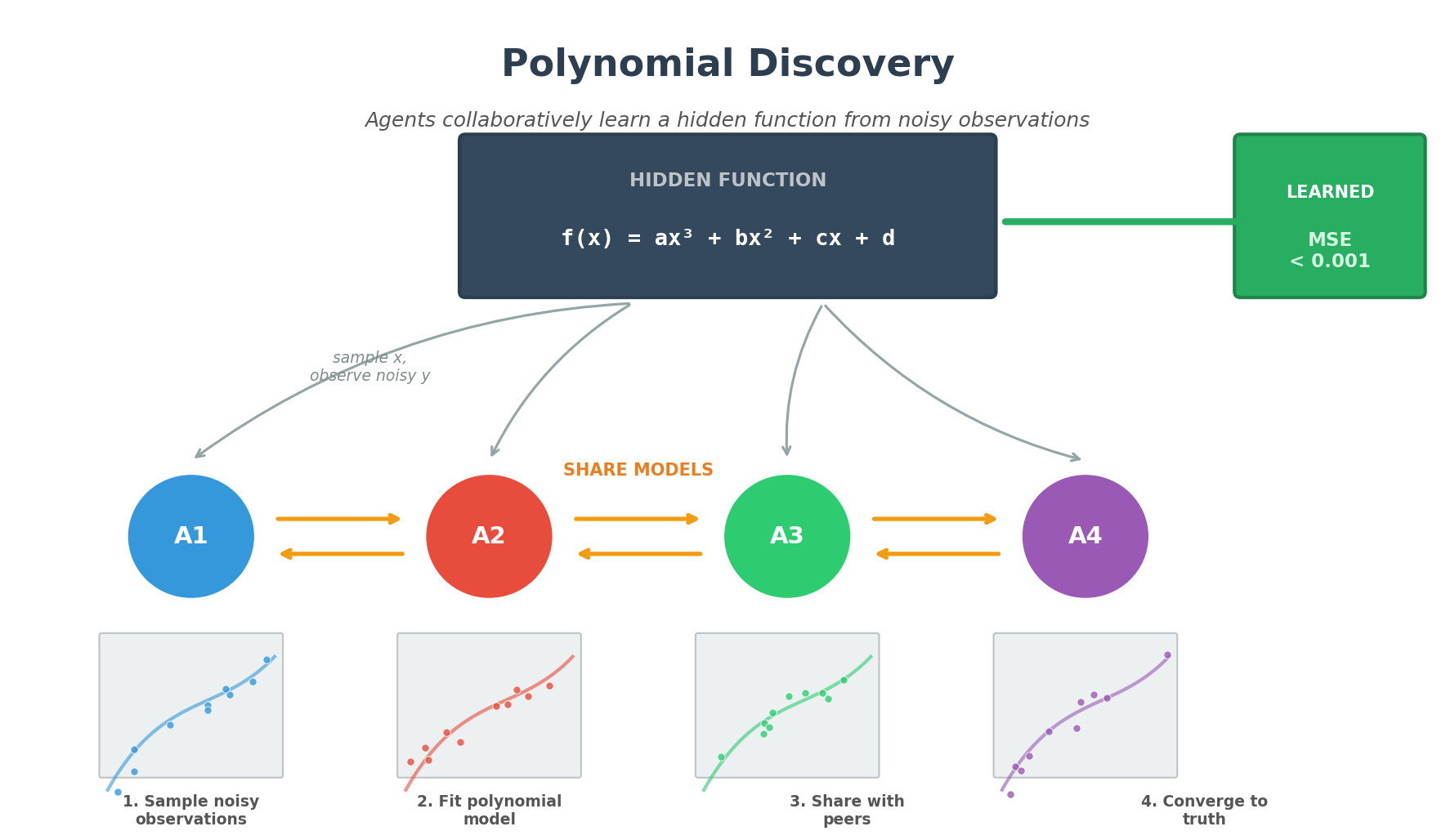
Problem
Multiple independent “scientist” agents attempt to discover a hidden cubic polynomial:
f(x) = ax³ + bx² + cx + d
What agents know:
- The functional form is cubic (4 parameters to learn)
- They can sample x values from [-1, 1]
What agents DON’T know:
- The true coefficients (a, b, c, d)
- They only observe noisy measurements:
y = f(x) + noise
Evaluation:
- MSE is measured against the hidden ground-truth function on a dense evaluation grid
- This is an “oracle” metric - agents cannot compute it themselves
Agent Architecture
Each agent runs an asynchronous loop (not synchronized with other agents):
- Sample: Draw random x, observe noisy y
- Fit: Periodically refit model parameters using least squares
- Receive: Process messages from peers (model parameters)
- Integrate: Blend peer models with own (if peer seems better)
- Send: With probability
COMM_PROB, share model with a random peer
Installation
pip install -r requirements.txt
Usage
Basic Run
python independent_scientists_academy.py
Configuration via Environment Variables
export N_AGENTS=16
export COMM_PROB=0.12
export TOPOLOGY=ring    # ring | random | all
export STEPS=300
python independent_scientists_academy.py
Comparison Scripts
# Compare communication strategies (none vs ring vs random)
python compare_communication.py

# Compare across different hidden functions
python compare_problems.py

# Test scaling with agent count (1, 2, 4, 8, 16, 32, 64)
python compare_agent_counts.py
Sample Results
Single Run Dashboard (16 agents, 300 steps)
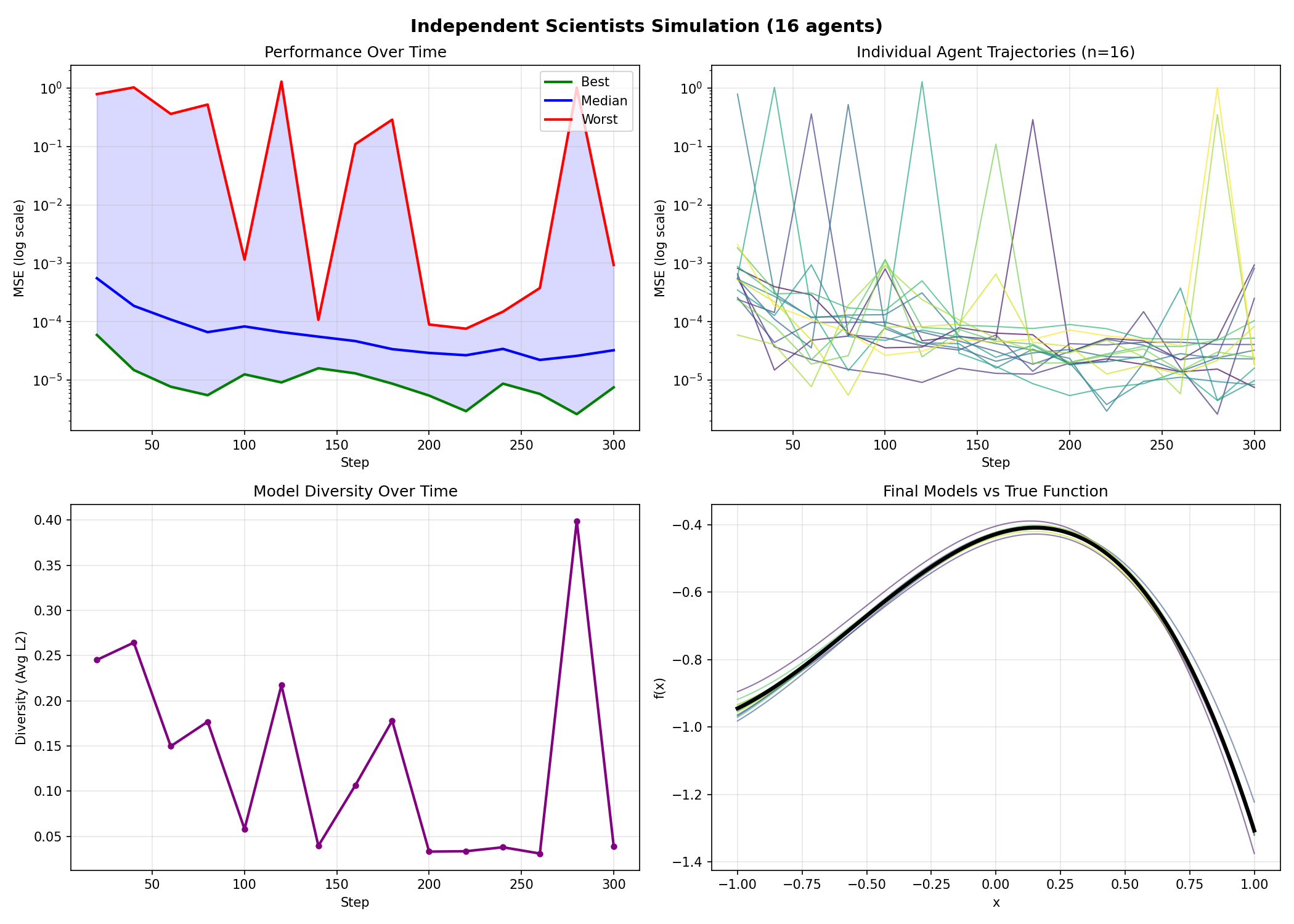
This shows:
- Top-left: MSE over time (best, median, worst agents)
- Top-right: Individual agent MSE trajectories
- Bottom-left: Model diversity decreasing as agents converge
- Bottom-right: Final agent models overlaid on true function
Communication Strategy Comparison
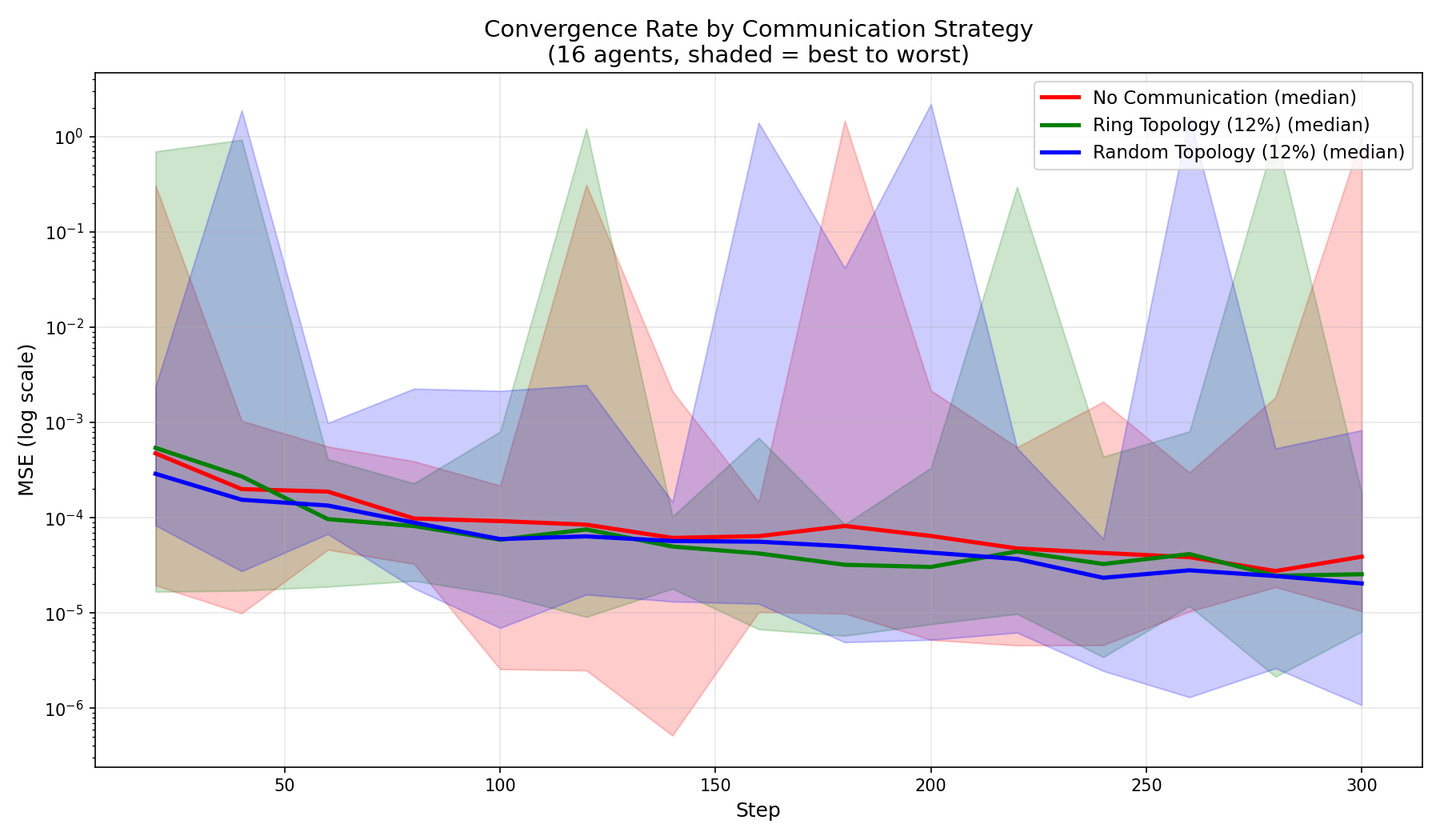
Comparing no communication vs ring topology vs random topology:
| Metric | No Comm | Ring (12%) | Random (12%) |
|---|---|---|---|
| Final Best MSE | 0.000010 | 0.000006 | 0.000001 |
| Final Median MSE | 0.000039 | 0.000025 | 0.000020 |
| Final Worst MSE | 1.013 | 0.000182 | 0.000830 |
| Total Messages | 0 | 1,355 | 1,403 |
Key finding: Communication dramatically reduces worst-case performance. Random topology gives slightly better average performance due to shorter path lengths.
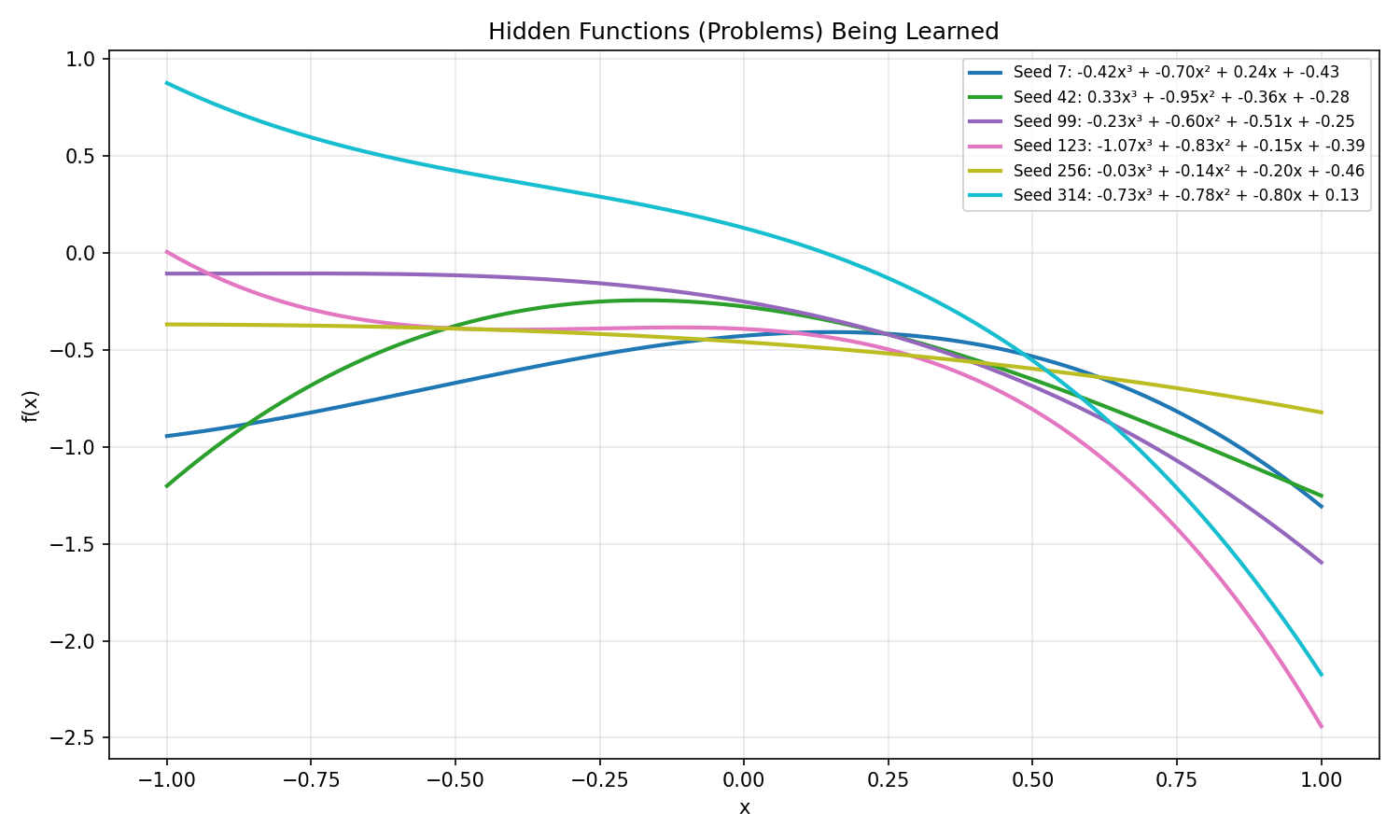
Performance Across Different Problems
Tested across 6 different hidden cubic functions:
| Strategy | Best MSE (mean±std) | Median MSE (mean±std) | Worst MSE (mean±std) |
|---|---|---|---|
| No Communication | 0.000016 ± 0.000003 | 0.000031 ± 0.000002 | 0.56 ± 0.82 |
| Ring (12%) | 0.000005 ± 0.000004 | 0.000028 ± 0.000007 | 0.19 ± 0.27 |
| Random (12%) | 0.000004 ± 0.000004 | 0.000025 ± 0.000006 | 0.08 ± 0.12 |
Win rates (best median MSE per problem):
- Random (12%): 4/6 wins (67%)
- Ring (12%): 2/6 wins (33%)
- No Communication: 0/6 wins (0%)
Agent Count Scaling
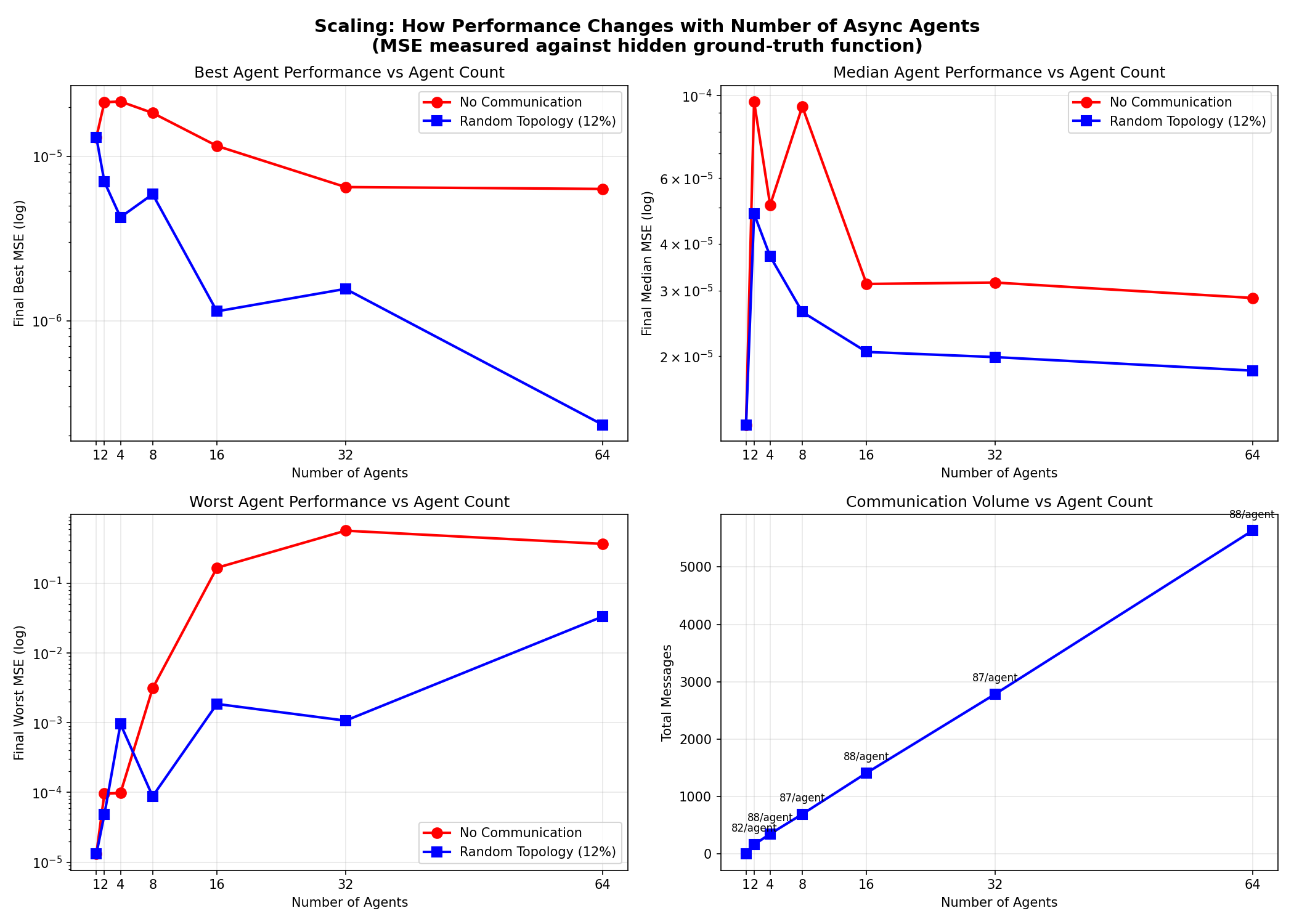
| Agents | With Comm | No Comm | Improvement | Messages |
|---|---|---|---|---|
| 1 | 0.000013 | 0.000013 | 1.00x | 0 |
| 2 | 0.000048 | 0.000096 | 2.00x | 163 |
| 4 | 0.000037 | 0.000051 | 1.37x | 350 |
| 8 | 0.000026 | 0.000093 | 3.56x | 694 |
| 16 | 0.000021 | 0.000031 | 1.52x | 1,412 |
| 32 | 0.000020 | 0.000032 | 1.58x | 2,786 |
| 64 | 0.000018 | 0.000029 | 1.57x | 5,631 |
Key findings:
- Sweet spot around 8-16 agents
- Linear message scaling (~88 msgs/agent)
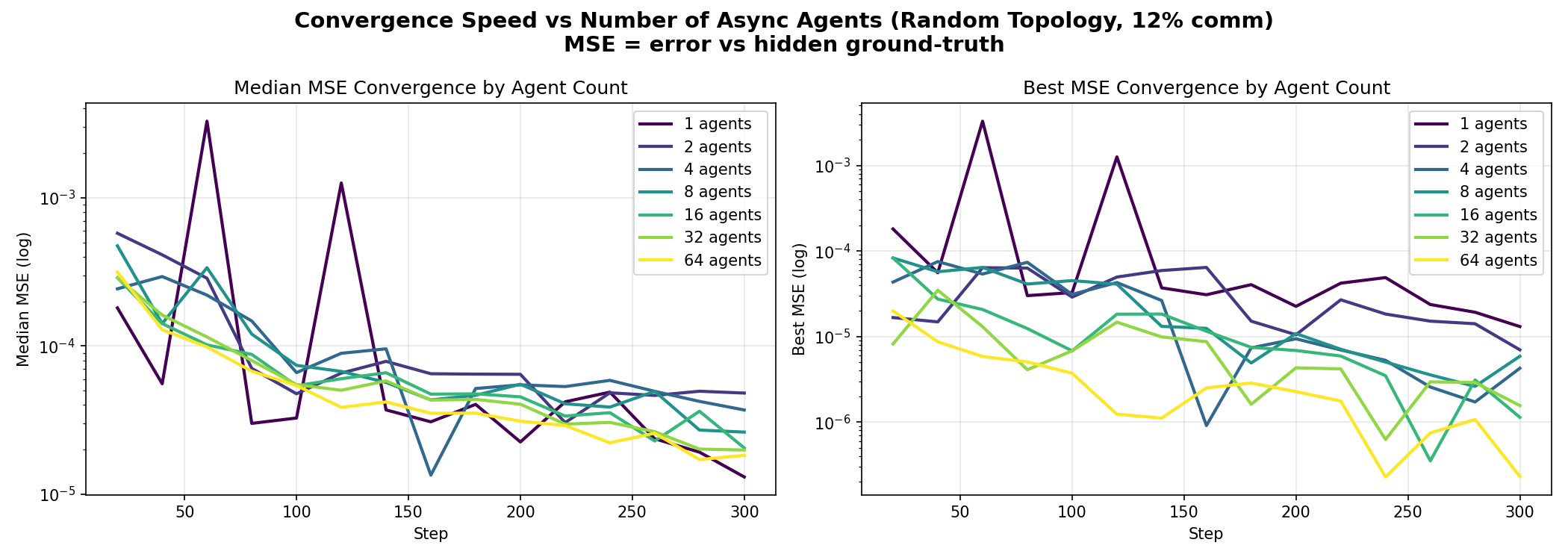
- Best agent keeps improving with more agents
- Diminishing returns on median performance after ~16 agents
Key Insights
-
Communication helps most for worst-case: Isolated agents can get stuck in local minima; peer information helps escape
-
Random topology > Ring topology: Shorter average path length allows faster information spread across the network
-
Sparse communication is sufficient: 12% send probability (~80 messages per agent) provides most of the benefit
-
Asynchronous operation works: No need for synchronized steps; agents learn effectively at their own pace
-
Scaling efficiency: More agents help exploration, but communication overhead grows linearly
Files
| File | Description |
|---|---|
independent_scientists_academy.py |
Main simulation with configurable parameters |
compare_communication.py |
Compare no-comm vs ring vs random topology |
compare_problems.py |
Test across 6 different hidden functions |
compare_agent_counts.py |
Scale from 1 to 64 agents |
requirements.txt |
Python dependencies |