
Bursar: Agent-Native HPC
Campaign-level resource leases and machine-speed back pressure for autonomous science
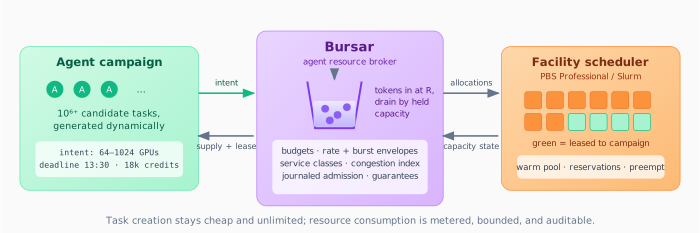
HPC facilities were built around human-scale submission: a person prepares jobs, queues a manageable number, and waits. Agentic scientific workflows invert every one of those assumptions — an agent may make thousands of resource decisions per second, generate task spaces with millions of contingent branches, and need answers in seconds because computation sits inside a closed experimental or reasoning loop.
The challenge: Simply removing job-count limits would expose the batch scheduler to machine-scale demand while leaving the real scarcity problem untouched. An allocation says how many GPU-hours a project may consume over months; it says nothing about how much it may consume right now, at what latency, and at what cost to everyone else on a fully subscribed machine.
A potential solution: Bursar — named for the institutional officer who meters budgets and, here, bursts — is a thin Agent Resource Broker above the facility scheduler (PBS Professional, Slurm). Projects receive campaign-level resource envelopes: a credit budget plus flow controls — guaranteed rate, sustained ceiling, burst allowance metered by a token bucket, and a service class that makes latency an explicit, priced attribute. Agents acquire short-lived leases against those envelopes through a machine API and run arbitrarily many fine-grained tasks inside them. The facility governs the rate of resource consumption, never the number of tasks: task creation stays cheap and unlimited, while consumption is bounded, machine-readable, and auditable.
How an application interacts with Bursar
Your project registers a campaign and receives an envelope. At runtime your application talks to Bursar’s API, not the scheduler: it queries supply (free capacity, congestion index, its own token balance, expected wait per grant path), states an intent (“64–1,024 GPUs for independent tasks, deadline 13:30, max spend 18,000 credits”), and receives a lease — typically in seconds from a warm pool. Inside the lease, your execution layer (Parsl, Ray, Flux, MPI pools…) dispatches tasks at whatever rate it likes; the facility scheduler never sees them. As prices and capacity shift, an adaptive agent reorders its science to run the highest-value work when capacity is cheap — back pressure becomes an input to scientific planning rather than a queue you wait in.
Using Bursar from Parsl
Most closed-loop campaigns already run on an execution framework, so the framework — not the application — is the right integration point. The Parsl provider maps Parsl’s own elasticity onto Bursar’s lease model: when Parsl scales out, the provider reads the supply API and negotiates a lease sized to what is actually grantable; when Parsl scales in, the lease is released; and if Bursar revokes or expires a lease, the provider tears its block down and lets Parsl’s scaling strategy negotiate a replacement — the broker’s word is enforced, not advisory. The entire integration surface for an application team is the provider block in the Parsl config:
provider = BursarProvider(
    campaign="my-campaign",
    base_url="https://bursar.example.gov",
    token=CAMPAIGN_TOKEN,               # campaign-scoped credential
    gpus_per_block=64, lease_duration=600, adaptive=True,
    init_blocks=1, min_blocks=0, max_blocks=3)

config = Config(executors=[HighThroughputExecutor(provider=provider, ...)])
Everything else — @python_app code, futures, dependencies — is ordinary Parsl. parsl_demo.py runs end-to-end against the simulated pool in about fifteen seconds; watch Parsl’s scaling strategy negotiate three warm-path leases and release them on cleanup. Globus Compute and Ray adapters would follow the same shape.
Documents
Bursar: Agent-Native HPC
The proposal (discussion draft, August 2026)
Campaign envelopes, token-bucket back pressure, service classes and credit pricing, the supply/intent API, warm/reclaim/cold lease paths, admission control and overbooking policy, governance and failure semantics, and a nine-month two-phase ALCF pilot with quantitative success thresholds.
Key topics: resource envelopes, token buckets, lease paths, congestion index, journaled admission, pilot design
Parsl provider
Framework adapter — blocks as leases
A Parsl execution provider that draws capacity from Bursar instead of submitting scheduler jobs: each Parsl block is a Bursar lease, negotiated over the REST API and sized to live supply signals. An application that runs on Parsl joins a Bursar pilot by changing its provider config; the science code does not change.
See it run: parsl_demo.py — an ordinary Parsl workflow on leased capacity
Live simulation replay
Interactive demo — press Play
An animated replay of the prototype: a 512-GPU pool, two hours simulated, five campaigns. Watch an adversarial burst storm get throttled by its token bucket, a small interactive campaign keep 1-second grant latency straight through the storm, and an adaptive agent produce ~2.2× the science of a naive one at ~2.5× lower cost with identical tasks.
Shows: pool occupancy, bucket levels, congestion multiplier, every lease grant by latency and path, and the I/O + inference envelope dimensions in action
Prototype
The prototype/ directory contains a runnable, zero-dependency simulation of the Bursar policy engine (the paper’s Phase 1: broker + synthetic load — the cluster is simulated, the policy engine is real):
cd prototype
python3 main.py && open report.html   # offline simulation + animated replay
python3 api.py --speed 20             # REST facade: the broker as a live service
python3 demo_client.py                # an agent negotiating with it over HTTP
python3 experiments.py                # parameter sweeps -> figures/ (needs matplotlib)
python3 parsl_demo.py                 # a real Parsl workflow on Bursar leases (needs parsl)
It demonstrates, in under a second of wall-clock time:
- Back pressure works — an adversarial campaign demanding its 384-GPU burst ceiling continuously is held to a 148-GPU average and forced back toward its 64-GPU sustained rate as its token bucket drains — and under prepaid-lease enforcement it can never hold a burst its tokens cannot pay for.
- Isolation holds — a small interactive campaign sees p95 grant latency of 1 s during the storm, because consumption beyond any campaign’s guarantee can never squeeze another campaign’s unmet guarantee.
- Adaptivity pays — given identical task sets, an agent that reads supply signals produces ~2.2× the science at ~2.5× lower credit cost per unit than one that ignores them, by deferring low-value work to cheap capacity, preferring high-value-per-gigabyte tasks when I/O-starved, and not holding GPUs it cannot feed.
- Utilization survives — preemptible backfill recovers idle capacity (~82% mean utilization in the default scenario).
- Envelopes are multi-dimensional — filesystem bandwidth and model inference are metered with the same token-bucket semantics as GPUs (throttle-at-source): the I/O-blind naive agent loses ~40% of its science to I/O throttling, and the storm’s inference spam is pinned to its sustained rate. Even the adversary’s thinking is metered.
- Governance is auditable — every admission decision is journaled with its rule inputs (service class, fair-share deficit, token state).
- The broker is a service, not a library —
api.pyexposes the supply, lease, and consumption APIs over HTTP with campaign-scoped bearer tokens and an OpenAPI description at/openapi.json;demo_client.pyshows an agent negotiating the full loop remotely. - Joining a pilot is a config change, not a rewrite —
parsl_provider.pyis a Parsl execution provider that maps each Parsl block to a Bursar lease: scale-out negotiates a lease sized to live supply signals, scale-in releases it, and a revoked lease tears its block down. The science code inparsl_demo.pyis ordinary Parsl; the whole integration surface is the provider block in the Parsl config.
Measured findings from parameter sweeps
experiments.py sweeps the scenario’s policy knobs (multiple seeds per point; latency measured by a standardized 128-GPU probe timed to full capacity). Three findings, now folded into the paper:
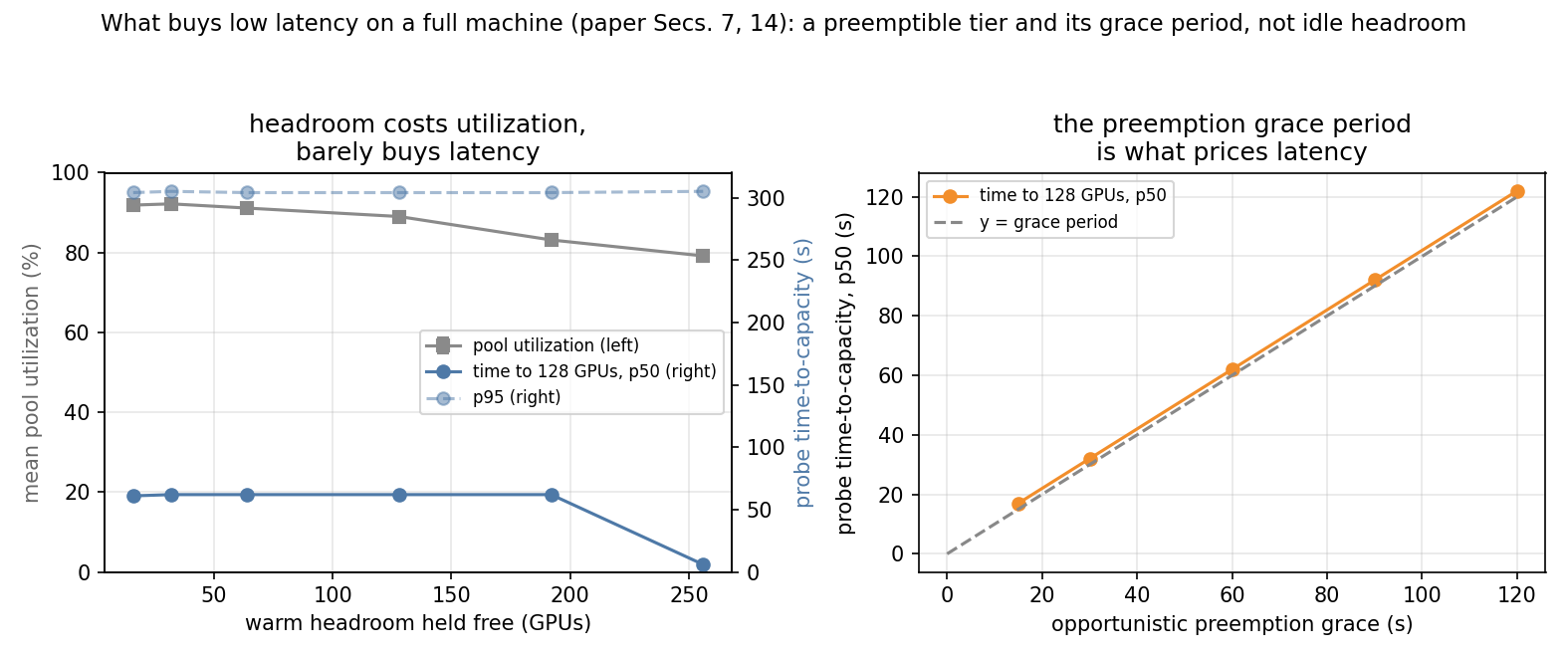
1. The preemption grace period — not idle headroom — prices latency. Reserving more warm headroom costs utilization but barely moves time-to-capacity, because a work-conserving preemptible tier refills spare GPUs anyway; median time-to-128-GPUs instead tracks the opportunistic preemption grace one-for-one.
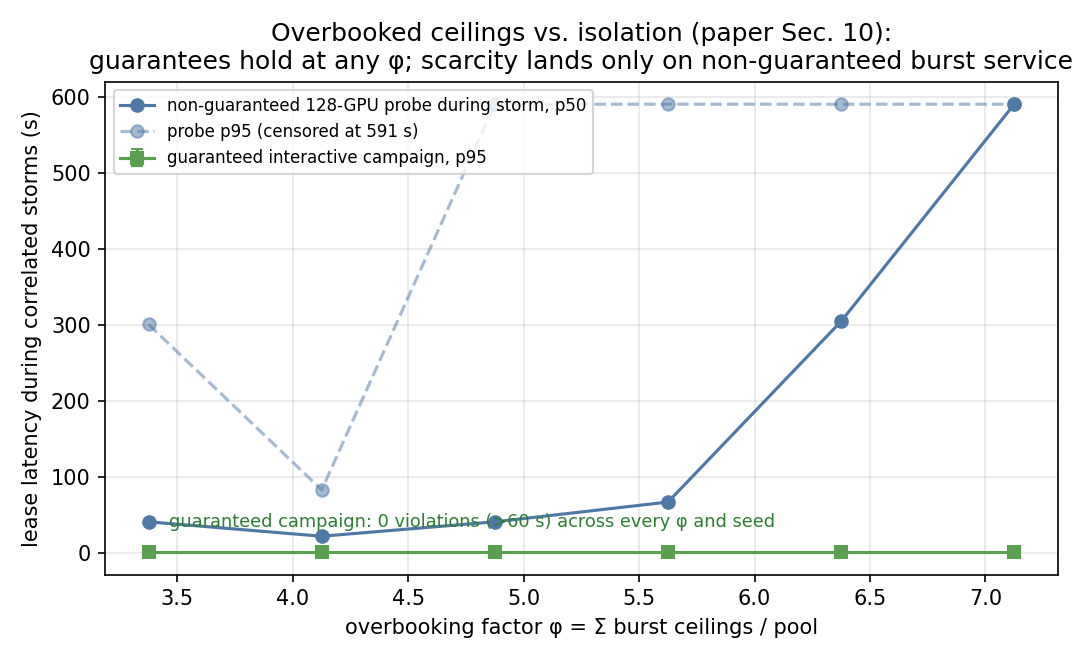
2. Guarantees survive 7× overbooking. With correlated adversarial storms pushing the sum of burst ceilings to 7.1× the pool, the guaranteed campaign stays at p95 = 1 s with zero violations at every overbooking factor; scarcity lands entirely on non-guaranteed burst service.
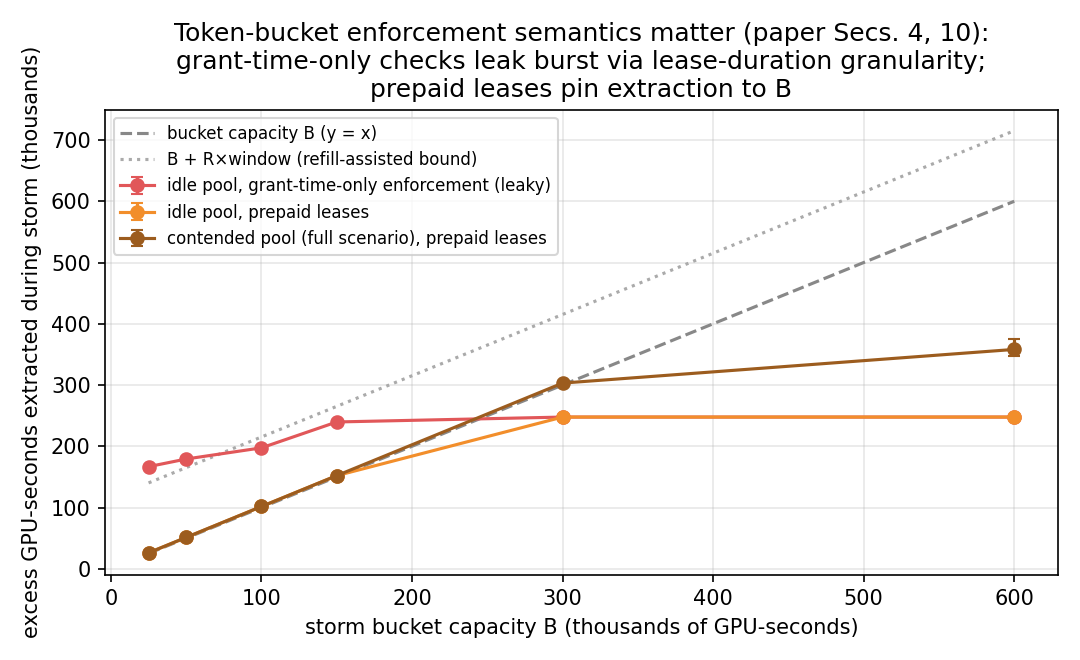
3. Token buckets need lease-aware enforcement. Checking tokens only at grant instants leaks burst through lease-duration granularity: an adversary with a 25k GPU-second bucket extracted 167k GPU-seconds. Prepaid leases — the above-sustained portion of a lease must be token-covered for its whole duration — pin extraction to B almost exactly, and are now the broker’s default.
Relationship to the Resource Rights Architecture
Bursar and the Resource Rights Architecture are complementary halves of one problem. Resource rights govern authority: what an agent is permitted to do, delegated and revocable across federated facilities. Bursar governs capacity and rate: how fast a permitted campaign may consume scarce resources, at what latency, and at what opportunity cost. An agent presents a resource right to prove it may act; Bursar decides whether it may act now, and meters what acting costs.
Status: discussion draft and simulation prototype. A facility pilot (PBS Professional binding at ALCF, Slurm binding for portability) is proposed in the paper.