Academy Remote Tools
Demonstrates how Academy agents can provide tools that other agents call remotely.
Code: View on GitHub
The Pattern
This example shows a key pattern for distributed scientific computing: tools as agent actions.
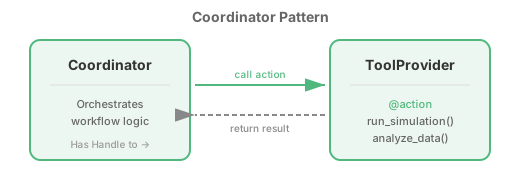
Why this matters:
- Separation of concerns: Coordinator handles workflow logic; ToolProvider handles compute
- Scalability: ToolProvider can run on HPC, cloud, or lab instruments
- Security: Academy’s identity and policy layer controls who can call what
- Flexibility: Same coordinator can work with different tool providers
Running the Example
cd Capabilities/local-agents/AgentsRemoteTools
python -m venv .venv && source .venv/bin/activate
pip install -r requirements.txt
python main.py
Custom task:
python main.py --task "analyze protein folding data"
Example Output
============================================================
ACADEMY REMOTE TOOLS EXAMPLE
============================================================
Task: optimize molecular structure for catalysis
------------------------------------------------------------
16:30:00 [academy.remote] Launched ToolProvider: ...
16:30:00 [academy.remote] Launched Coordinator: ...
16:30:00 [academy.remote] [Coordinator] Tool provider configured
16:30:00 [academy.remote] [Coordinator] Starting workflow for: optimize...
16:30:00 [academy.remote] [Coordinator] Tool provider status: ready
16:30:00 [academy.remote] [Coordinator] Step 1: Running initial simulation
16:30:00 [academy.remote] [ToolProvider] Starting simulation SIM-0001
16:30:00 [academy.remote] [ToolProvider] Completed SIM-0001: energy=-125.32
16:30:00 [academy.remote] [Coordinator] Step 2: Analyzing data
16:30:00 [academy.remote] [ToolProvider] Analyzing SIM-0001 with statistical
16:30:01 [academy.remote] [Coordinator] Step 3: Running optimized simulation
16:30:01 [academy.remote] [ToolProvider] Starting simulation SIM-0002
16:30:01 [academy.remote] [ToolProvider] Completed SIM-0002: energy=-129.47
16:30:01 [academy.remote] [Coordinator] Workflow complete: improvement=4.15
------------------------------------------------------------
WORKFLOW RESULTS
------------------------------------------------------------
Status: completed
Steps completed: 3

Summary:
  Initial energy:   -125.32
  Optimized energy: -129.47
  Improvement:      4.15
============================================================
Key Concepts
1. Tools as Agent Actions
Any @action method can be called remotely by other agents:
class ToolProviderAgent(Agent):
    @action
    async def run_simulation(self, parameters: dict) -> dict:
        # Expensive computation here
        return {"energy": -127.5, "status": "completed"}
2. Handle-Based Tool Access
The coordinator receives a Handle to the tool provider and calls its actions:
class CoordinatorAgent(Agent):
    def __init__(self):
        self._tool_provider: Handle | None = None

    @action
    async def set_tool_provider(self, provider: Handle) -> None:
        self._tool_provider = provider

    @action
    async def execute_workflow(self, task: str) -> dict:
        # Call tools on the remote provider
        result = await self._tool_provider.run_simulation(
            parameters={"temperature": 300.0}
        )
        return result
3. Multi-Step Workflows
The coordinator can chain multiple tool calls:
# Step 1: Run simulation
sim_result = await self._tool_provider.run_simulation(params)

# Step 2: Analyze results
analysis = await self._tool_provider.analyze_data(sim_result["job_id"])

# Step 3: Optimized run based on analysis
optimized = await self._tool_provider.run_simulation(new_params)
Production Deployment
In production, this pattern enables powerful distributed scenarios:
| Component | Development | Production |
|---|---|---|
| ToolProvider | Same machine | HPC login node, instrument computer, cloud VM |
| Coordinator | Same machine | User workstation, workflow service, AI agent |
| Exchange | LocalExchangeFactory | GlobusComputeExchange, RedisExchange |
The code remains identical - only the exchange factory changes:
# Development
factory = LocalExchangeFactory()

# Production (example - actual API may vary)
factory = GlobusComputeExchange(endpoint_id="hpc-cluster-xyz")
Comparison to Other Patterns
| Pattern | Coordination | Best For |
|---|---|---|
| Remote Tools (this) | Explicit tool calls | HPC jobs, instruments, expensive compute |
| Pipeline | Agent-to-agent forwarding | Sequential processing |
| Hub-and-Spoke | Central orchestration | Simple workflows |
Related Examples
Prerequisites:
- AgentsAcademyBasic - Academy fundamentals (start here if new)
Next steps:
- AgentsHybrid - Add LLM reasoning to Academy agents
- AgentsPersistent - Checkpoint and resume workflows
- AgentsFederated - Cross-institutional collaboration
- Federated Agent Execution - Production deployment on HPC
- Governed Tool Use - Add policy enforcement
Requirements
- Python 3.10+
- academy-py