Multi-Agent Coordination
Multiple agents sharing budget, state, and policies.
Code: View on GitHub
What It Does
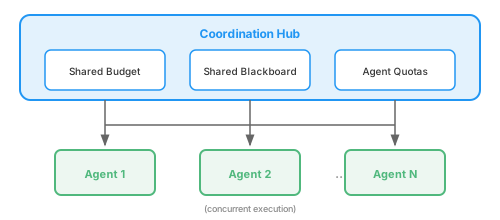
Demonstrates coordination patterns for concurrent agents:
- Shared budget: All agents draw from a common resource pool
- Shared blackboard: Agents post findings for others to read
- Task claiming: Prevent duplicate work across agents
- Per-agent quotas: Limit operations per agent
- Event logging: Track all coordination activity
Running the Example
cd Capabilities/multi-agent-coordination/AgentsCoordination
python -m venv .venv && source .venv/bin/activate
pip install -r requirements.txt
python main.py
Custom configuration:
python main.py --agents 5 --budget 200 --tasks 10
LLM Configuration
Supports OpenAI, FIRST (HPC inference), Ollama (local), or mock mode.
See LLM Configuration for details.
Coordination Architecture
Key Patterns
Thread-safe shared budget:
@dataclass
class SharedBudget:
    total: float
    spent: float = 0.0
    _lock: threading.Lock = field(default_factory=threading.Lock)

    def request(self, amount: float, agent_id: str) -> tuple[bool, str]:
        with self._lock:
            if self.spent + amount > self.total:
                return False, "Insufficient budget"
            self.spent += amount
            return True, f"Allocated ${amount}"
Task claiming to prevent duplicate work:
def claim_task(self, task_id: str, agent_id: str) -> tuple[bool, str]:
    with self._lock:
        if task_id in self._claims:
            return False, f"Already claimed by {self._claims[task_id]}"
        self._claims[task_id] = agent_id
        return True, "Claimed"
Blackboard for sharing findings:
def post(self, key: str, value: any, agent_id: str):
    with self._lock:
        self._data[key] = {
            "value": value,
            "posted_by": agent_id,
            "timestamp": datetime.now().isoformat()
        }
Tools
| Tool | Description |
|---|---|
request_budget |
Request allocation from shared budget |
post_finding |
Share a finding on the blackboard |
read_findings |
Read all findings from blackboard |
claim_task |
Claim a task (prevents duplicates) |
release_task |
Release a claimed task |
check_budget_status |
Check shared budget |
get_my_quota |
Check this agent’s quota |
Example Output
============================================================
MULTI-AGENT COORDINATION
============================================================
Agents: 3
Total budget: $100.00
Tasks: 6
============================================================

[Agent_1] Task 'Analyze' claimed by Agent_1
[Agent_1] Allocated $10.00 to Agent_1. Remaining: $90.00
[Agent_1] Posted 'Agent_1_result' to blackboard

[Agent_2] Task 'Run' claimed by Agent_2
[Agent_2] Allocated $10.00 to Agent_2. Remaining: $80.00
[Agent_2] Posted 'Agent_2_result' to blackboard

============================================================
COORDINATION SUMMARY
============================================================

Budget: $60.00 / $100.00 (60.0% used)

Shared findings (6):
  - Agent_1_result: Result from Agent_1: analysis complete...
  - Agent_2_result: Result from Agent_2: analysis complete...

Recent coordination events:
  [Agent_1] budget_request: Allocated $10.00
  [Agent_2] post_finding: Posted 'Agent_2_result'
Production Considerations
This example uses in-memory coordination. Production systems should:
- Distributed state: Use Redis, etcd, or database for shared state
- Persistent budget: Track spending in durable storage
- Failure handling: Release claimed tasks if agent crashes
- Priority queues: Handle high-priority tasks first
- Load balancing: Distribute work based on agent capacity
Requirements
- Python 3.10+
- LangGraph 1.0+
- OpenAI API key, FIRST token, Ollama, or run in mock mode