Getting Started: Building Scientific Agents
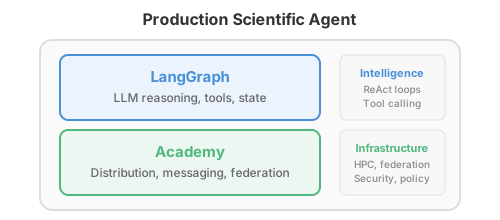
Production scientific agents need two capabilities:
- Intelligence — LLM-powered reasoning, tool calling, and decision making
- Distribution — Running across machines, institutions, and federated infrastructure
No single framework does both well. That’s why we use two complementary frameworks:
| Framework | What It Does | Strengths |
|---|---|---|
| LangGraph | LLM reasoning and tool orchestration | ReAct patterns, state management, tool calling |
| Academy | Distributed agent execution | Cross-machine messaging, federation, HPC integration |
Learning Path
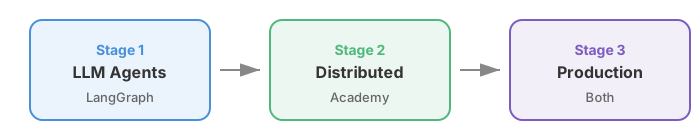
This guide walks you through both frameworks, building toward production agents:
| Stage | Guide | What You Learn |
|---|---|---|
| 1 | LLM Agents | Build agents that reason and call tools (LangGraph) |
| 2 | Distributed Agents | Run agents across machines (Academy) |
| 3 | Production Agents | Combine LangGraph + Academy for real deployments |
Time investment: Each stage builds on the previous. Plan to work through them in order.
Stage 1: LLM Agents (LangGraph)
Learn to build agents that can reason and use tools.
from langchain_openai import ChatOpenAI
from langgraph.prebuilt import create_react_agent

@tool
def calculate(expression: str) -> str:
    """Evaluate a math expression."""
    return str(eval(expression))

llm = ChatOpenAI(model="gpt-4o-mini")
agent = create_react_agent(llm, [calculate])
agent.invoke({"messages": [HumanMessage(content="What is 347 * 892?")]})
Key concepts: Tools, ReAct loop, state graphs, memory
Stage 2: Distributed Agents (Academy)
Learn to run agents across machines and pass messages between them.
from academy.agent import Agent, action
from academy.manager import Manager

class ComputeAgent(Agent):
    @action
    async def run_simulation(self, params: dict) -> dict:
        # Could run on HPC, lab instrument, cloud...
        return {"energy": -127.5, "status": "completed"}

async with await Manager.from_exchange_factory(factory) as manager:
    compute = await manager.launch(ComputeAgent)
    result = await compute.run_simulation({"temp": 300})
Key concepts: Agent classes, @action methods, Handles, Manager
Stage 3: Production Agents (LangGraph + Academy)
Combine both: LLM reasoning inside distributed Academy agents.
class ResearchAgent(Agent):
    """Academy agent with LangGraph intelligence."""

    @action
    async def research(self, task: str) -> dict:
        # LangGraph handles reasoning
        result = self._langgraph_agent.invoke({
            "messages": [HumanMessage(content=task)]
        })
        return {"findings": result["messages"][-1].content}
Key patterns:
- Academy handles distribution, messaging, federation
- LangGraph handles LLM reasoning inside each agent
- Same code runs locally or across DOE infrastructure
Quick Decision Guide
“I just want to experiment with LLM agents locally” → Start with Stage 1 (LangGraph only)
“I need agents on HPC/federated infrastructure but no LLM yet” → Start with Stage 2 (Academy only)
“I need LLM-powered agents on DOE infrastructure” → Work through all three stages, ending with Stage 3
Examples by Stage
| Stage | Examples | Pattern |
|---|---|---|
| 1 | Calculator, RAG, Database, API | LangGraph tools |
| 1 | Conversation, LangGraph Pipeline | LangGraph state |
| 2 | AcademyBasic, RemoteTools | Academy messaging |
| 2 | Persistent, Federated | Academy patterns |
| 3 | Hybrid | LangGraph + Academy |
| 3 | HPC Job, CharacterizeChemicals | Production deployment |
Prerequisites
- Python 3.10+
- For Stage 1:
pip install langchain langchain-openai langgraph - For Stage 2:
pip install academy-py - For Stage 3: Both of the above
LLM access: Examples support OpenAI, Ollama, and FIRST backends. See LLM Configuration for setup. All examples include mock mode for testing without API keys.